Summer Sensory Activities for Autism: Nature’s Occupational Therapy for Sensory-Seeking Children.
Published on
June 7, 2026


I'm lying in bed trying to get Davy down for a nap after a long morning.
He slips out. A few minutes later I hear the familiar clink of Magnatiles and think, Great. He's building something. I'm in the clear.
Somewhere between dreams and reality, I hear a tiny voice announce:
"Mommy, made powder!"
I launched out of bed like the house was on fire.
It was.
There stood Davy, and the kitchen, and every cabinet, and somehow half the house, all buried in a flour blizzard. The taps were running freely, turning that beautiful powdery snow into thick dough that worked its way into every crack and crevice for days. Pretty sure I can bake bread on the bottom of my shoes.
This only narrowly beat last Friday, when he unboxed and cracked every single egg from a tray of 30 and let them run down the hallway. The impressive part? He thoughtfully collected every shell and placed them neatly into a cup, as though he was prepping ingredients for a cake instead of creating the most disastrous homemade sensory bin in history.
If you're raising a sensory seeker, you probably have your own version of this story. Mud in the shoes. Rocks in every pocket. Soap squeezed into places you didn't know soap could reach. A child who can somehow detect a puddle in a desert.
These kids are creative, determined, and endlessly curious. They are also, if we are being completely honest, exhausting.
For a long time, I thought I was raising the messiest child on earth. Countless comments from well-meaning strangers left me feeling self-conscious and out of control. But watching my son repeat the same behaviors over and over, regardless of consequence, I finally understood:
He wasn't trying to create chaos. He was regulating his nervous system.
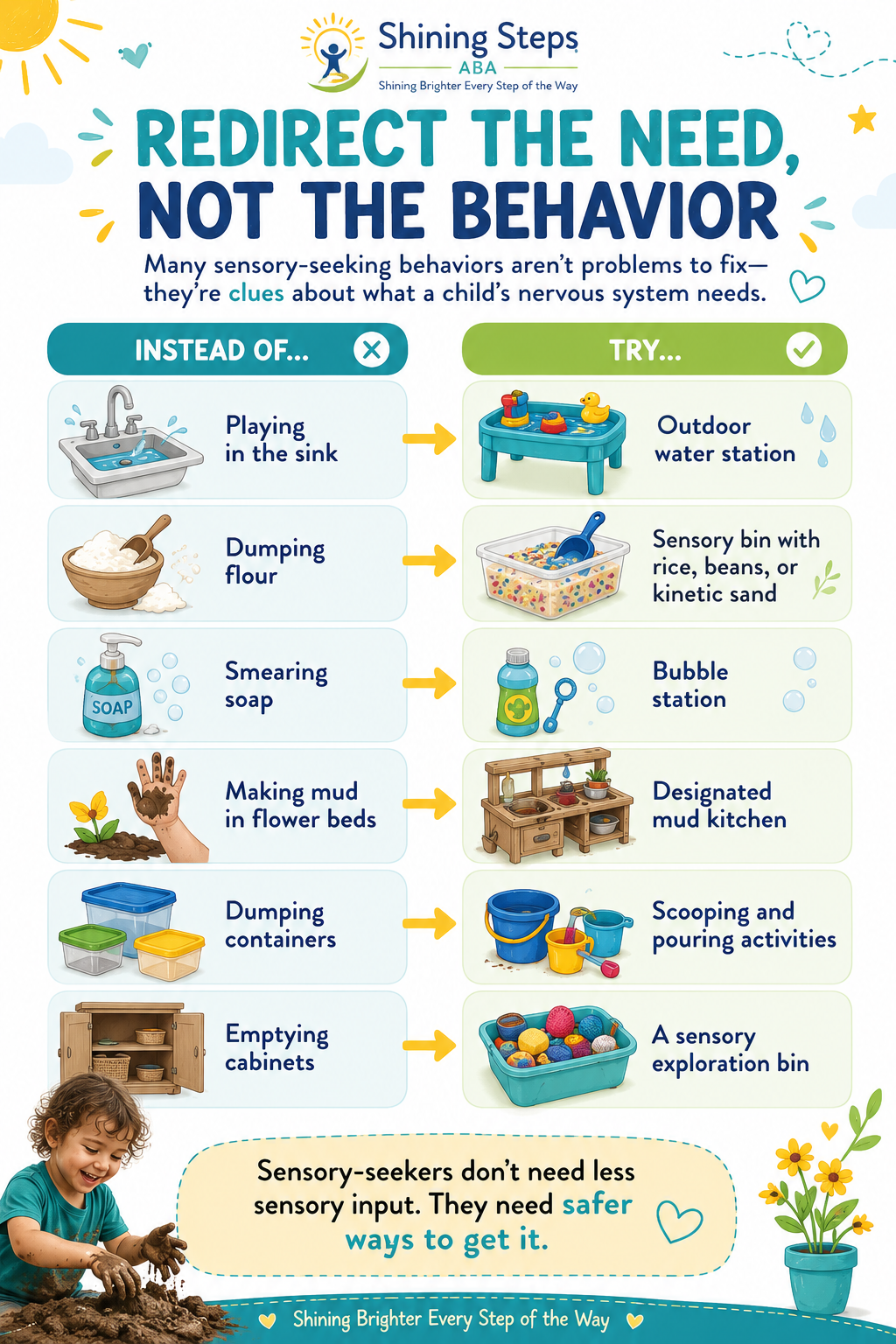
When a child repeatedly seeks water, mud, soap, flour, or leaves, the question isn't ‘why won't they stop? Rather, “what sensory need is this meeting?”
Sensory-seeking behavior is the nervous system's way of asking for input it needs to feel organized and calm. For many children with autism spectrum disorder, the brain processes sensory information differently, and the body responds by actively searching for more. More texture. More pressure. More movement. More mess.
That doesn't mean we allow destructive behavior. It means we redirect the need instead of simply punishing the behavior. When we understand the "why" behind what our children do, we can help them meet their needs in a safe way, while maintaining our sanity (hopefully.)
And that's exactly why summer can be nature's best occupational therapy. Research suggests natural environments support attention, regulation, stress reduction, and social engagement in many children.1,2
For sensory-seeking children, summer offers endless opportunities to get the sensory input they’ve been searching for all year.
The outdoors is essentially a free sensory gym. You don't need special equipment or a therapy room. You just need to open the back door.
Water play, outdoor textures, full-body movement: these feel like regular summer activities. For kids with ASD, they double as therapy. The freedom to dig, climb, and get messy doesn't just make memories. It helps children feel calmer, more focused, and more grounded.
These simple summer sensory activities provide opportunities for movement, tactile exploration, and sensory regulation.
Water offers tactile and temperature input. Mud and digging provide resistance and deep pressure. Barefoot walking sends proprioceptive signals through the feet and legs. Movement through uneven terrain builds body awareness and coordination.4
The best part? Most of these feel like fun, not therapy- and can strengthen family bonds too.
Sensory-seeking children often hear "stop," "don't touch," and "leave that alone" dozens of times a day. Summer gives us a chance to join them instead of constantly trying to correct.
Try family water fights, obstacle courses, bug hunts, mud kitchens, sandcastles, or collecting rocks and shells. Get on the ground with them. Follow their lead. Let them be the expert for a while. The biggest gift we can give these children is interest in their unique little worlds.
Am I invested in anthills or tiny lizards? No. But when I crouch down to inspect a bug or help build a mud pie, it subtly communicates to my child: I see you. What matters to you matters to me. That builds trust.
Summer, with longer days and less pressure, is the perfect time to work on being present.
If you're reading this while mentally calculating how much mud, flour, or soap you've cleaned up this week, I see you.
A little preparation goes a long way:
Setting boundaries before the activity starts is far more effective than trying to stop it once your child is in the zone.
Another tip: : rinsing off with the hose, dumping the bucket, putting tools away. It makes the ending feel less abrupt.
There’s a small window between Davy calmly watering plants and turning the entire backyard into a swamp.
That’s because most sensory-seeking children have a sweet spot where sensory input helps them feel organized. Beyond this point behavior can look like:
When you notice these signs, it may be time to shift gears before things escalate. Trying to push through overstimulation rarely ends well.
One strategy I find helpful is switching to heavy work: activities involving pushing, pulling, carrying, or digging. These provide deep proprioceptive input that is highly grounding for the nervous system.4
Unlike high stimulation activities, heavy work helps the body slow down and reorganize.
Heavy work doesn't have to look like a break. It can be woven right into outdoor play and used as a tool to involve your child in cleanup and help transition toward wind-down time.
Not all autistic children seek sensory input. Some avoid it. If mud, grass, bugs, or sticky textures feel overwhelming for your child, follow their lead. Pushing a sensory-avoidant child into messy play can increase anxiety and erode trust.
The goal isn't messy play or nothing. It's finding experiences that help each child feel calm, connected, and regulated. That looks different for every child, and it may look different for the same child from one day to the next.
For one child, nature's OT might be a muddy creek and a bucket. For another, it might be sitting under a tree watching birds, feeling the breeze, or crunching leaves. Both are soothing.
Honor where your child is, not where you think they should be. When you stop to listen, really listen- their needs become abundantly clear.
Missouri families have no shortage of sensory-rich destinations to explore this summer.
Splash pads and sensory-friendly playgrounds
State parks and nature trails
Lakes and sandy beaches
Creek beds and stream exploration areas
Many state parks also offer quieter hours or less crowded options for a lower stimulation environment. Call ahead, plan for transitions, and bring your ‘rinse station.׳
I've spent plenty of afternoons cleaning up flour, mud, soap, and things I still can't identify. I've spent plenty of afternoons frustrated by it, too.
But summer gives us a chance to say yes a little more often.
Yes to getting wet. Yes to getting dirty. Yes to collecting bugs, digging holes, filling buckets over and over again.
Because sensory-seeking behaviors aren’t a problem to solve. They’re valuable information about what a child’s body and nervous system need.
When you shift from fighting it to working with it, the chaos starts to feel less like chaos and more like your child doing exactly what they need- within safe limits.
For many sensory-seeking children with autism, summer provides the movement, nature, and hands-on exploration that help them feel regulated, connected, and seen.
If you’re looking for individualized support for your sensory-seeking child with autism, we’re here to help.
At Shining Steps ABA, we work with you to understand the "why" behind your child’s behaviors and build practical strategies that support communication, calm, and independence in daily life.
Our family-centered care extends beyond therapy sessions and into the places that matter most: home, school, and community, at every season and stage.
Contact us to learn how we can help your child thrive this summer and beyond.