I Thought ABA Was Dumb. Here’s Where I Went Wrong.
Published on
January 19, 2026



Charts. That’s what I remember most.
Colored, laminated charts on the walls, the fridge, outside the bathroom. Morning routine charts. Afternoon routine charts. Evening routine charts. Our home was covered wall to ceiling. She was young and inexperienced. We were probably her first-ever ABA clients. She was sweet, well-meaning, and handed out a lot of tiny candies.
But I was drowning.
I did not see meaningful progress. He was still peeing on the floor and refusing to get dressed. Within a few months, those charts ended up in the garbage. A waste of perfectly good art. That was my introduction to ABA therapy, and honestly, it wasn’t impressive.
Once my son entered the special education system, we transitioned to DIR Floortime. It felt safer. More familiar. More respectful of where he was emotionally and developmentally. And for a while, it was the right fit.
But over time, I could not ignore a changing reality that put my smug attitude to the test. Families I knew with young autistic children were seeing remarkable success with ABA when it was done organically.
Which begs the question. Does ABA actually “suck,” or are we judging a modern therapy by its worst, outdated versions?
Spend any time in autism parent groups or ASD forums and the backlash against ABA becomes clear. For many, it is not just a therapy model. It’s tied to experiences that felt controlling, dismissive, or even harmful. Let’s explore this further.
Applied Behavior Analysis developed during a time when autism was poorly understood and psychology focused heavily on observable behavior. Early ABA demanded compliance; sitting still, making eye contact, suppressing stimming and completing repetitive tasks for rewards. Sensory needs, communication differences, and emotional regulation were overlooked. [1][2]
The stories are hard to ignore. One ASD teen described early ABA sessions where a therapist “put her hand on my chin to force eye contact and told me to use my words even though I was completely nonverbal.” Parents echo this from the other side. “My child learned how to comply, not how to cope.”
Research has since acknowledged the ethical limitations of these older models, especially when therapy was delivered without appropriate communication or sensory support. [3]
History matters. It explains why many families are skeptical, fearful, or will not touch ABA at all. Without addressing the elephant in the therapy room, it’s impossible to fully embrace ABA.
Negative reactions to ABA are valid. They come from real experiences that left families feeling unheard or harmed. But with an open mind and current research, it becomes clear that modern ABA, when done well, looks very different from the rigid programs of the past. [2]
Today’s ABA is often play-based and child-led. Children learn through routines, games, and real-life situations, supported by visuals and meaningful choices. [3][5] One parent shared, “When my son had choices, the meltdowns dropped dramatically.” Another said, “This didn’t feel like therapy. It felt like someone finally got my kid.”
One autistic teen described the difference between her former and current provider: “She asks permission before touching me, uses my AAC device, gives me breaks when I need them, and helps me solve problems instead of punishing me for struggling.”
That distinction matters. It is the line between harmful ABA and helpful ABA.
What I have noticed is a shift away from compliance and toward regulation and safety. Harmful behaviors are addressed, but harmless stimming is respected. Reinforcement feels natural. Preferred activities, independence, and connection replace candy or arbitrary rewards.
Research on play-based, child-led models such as the Early Start Denver Model supports this evolution, showing measurable improvements in language, social engagement, and adaptive skills. [5]
This does not erase ABA’s past, and it should not. But it does challenge the idea that ABA is one static, harmful approach. When practiced thoughtfully, modern ABA is not about changing who a child is. It is about helping them navigate the world more safely and successfully.
After my early experience with ABA, DIR felt like a breath of fresh air.
DIR, Developmental, Individual-differences, Relationship-based therapy, focuses on connection first. [4] It’s about emotional safety, shared attention, and meeting a child where they are. Instead of correcting behavior, it asks why a child is struggling and builds skills through play.
For many families, this feels instinctively right. There is less pressure, less fixing, and more trust. A parent in my ASD support group summed it up perfectly. “DIR helped me understand my child instead of trying to change him.”
For many children, especially those who are emotionally sensitive, verbally communicative, or not engaging in dangerous behaviors, DIR can be more than enough. It supports emotional regulation, flexibility, social connection, and parent-child bonding.
I saw this firsthand once my son entered special education. DIR aligned with what he needed in that phase. Safety. Predictability. Space to be himself. Progress felt organic, not forced. Slowly and patiently, the therapist entered his world using favorite toys and quirky isms-and it worked.
Over time, many of his challenges softened on their own. Sensory sensitivities eased. His window of tolerance expanded as his nervous system matured.
But that was not true for all his peers.
Some kids in my son’s high-functioning ASD classroom continued to struggle with daily life skills. Toileting stalled. Dressing triggered meltdowns. Small changes like a substitute teacher, fire drill, or snowstorm derailed their day. Parents still could not nail down a consistent routine.
DIR created emotional safety, but it did not provide the structure, repetition, or skill-building intensity needed to navigate real life. It was not enough.
That is where ABA, done thoughtfully, can make all the difference.
Today’s ABA is not a replacement for relationship-based therapy. It’s functional, flexible, and child-centered. Step-by-step routines, visual supports, and guided repetition make sessions predictable. Harmless stimming is respected, natural reinforcements replace candy, and simple changes like allowing my son to choose the order of his tasks made him far more cooperative.
Parents feel the change.
“When he got to choose what work to do and what he was working for, his tantrums were greatly reduced.”
“He loved going to therapy. He just played the whole time and had great relationships with his therapists.”
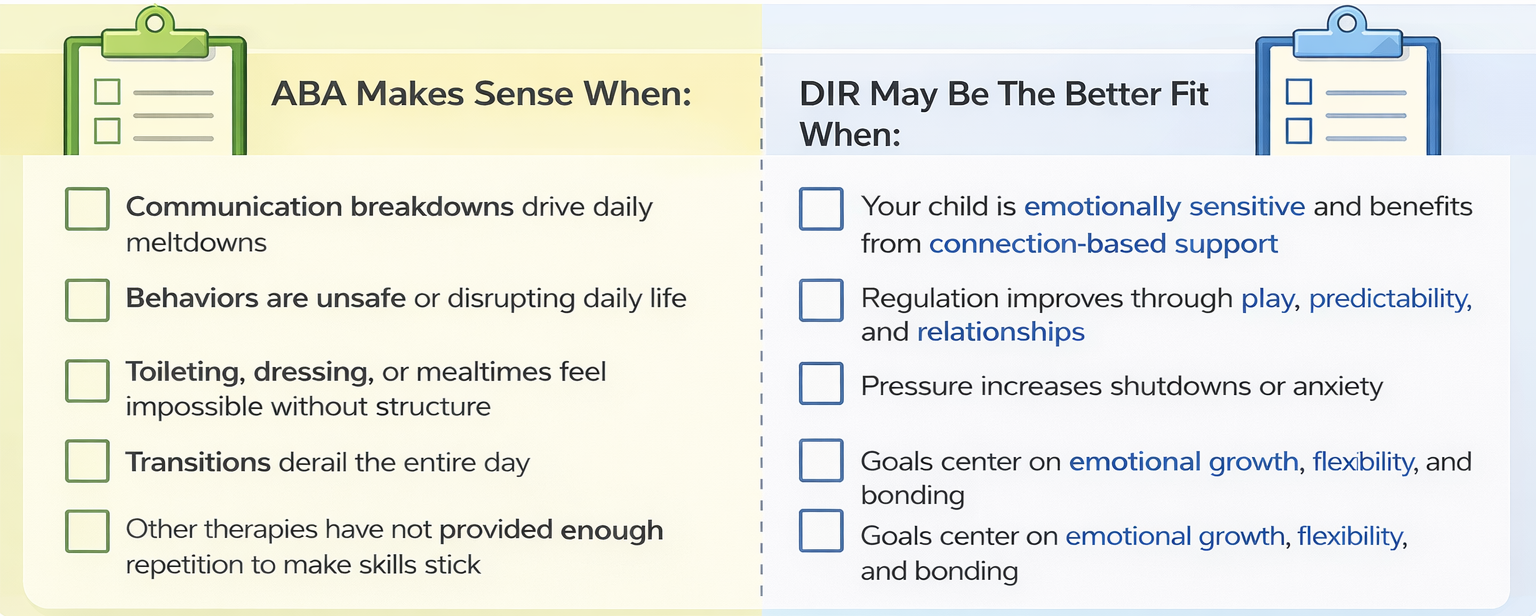
ABA tends to make sense when the goal is reducing daily friction, not fixing a child. It is about practicality, communication, and breaking down rough moments into clear, actionable steps.
ABA makes sense when:
DIR may be the better fit when:
What parents rarely hear is that you do not have to choose one forever. Many children start with one approach and later switch to the other. or benefit from both working in tandem. I have seen powerful results when the two are well-integrated.
Read this thread to hear more on the topic from real life parents.
At Shining Steps, therapy is collaborative and family-centered. Our BCBA’s coordinate with occupational and speech therapists, align strategies across school and home settings, and actively involve parents so skills transfer into real life.
Families share routines, triggers, and preferences. Therapy fits the child, not the other way around.
As one parent put it, “My son’s ABA team listens to us, incorporates suggestions from his OT and speech therapist, and helps him practice skills safely while having fun.”
This is exactly what was missing in my first ABA experience, and why it works when done right.
DIR and ABA are not enemies.
Connection and structure are not opposites. Children need both, in different ways and at different times.
Modern ABA does not erase autism. It equips children with tools to communicate their needs, manage change, and build independence without shame. Solid ABA is the bridge between emotional safety and real-world functioning.
If you want support that honors both connection and real-life skills, Shining Steps offers holistic, play-based ABA designed to work with your child, not against them.
Green Flags