5 At-Home Sensory Activities Your ASD Grade Schooler Won’t Hate
Published on
December 28, 2025


I hit a wall when my 8 year old ASD-er found interests that actually kept him busy for a solid chunk of time. He no longer lines up trucks and dinosaurs or memorizes geography books. He now prefers rereading Harry Potter and Percy Jackson dozens of times, building hundreds of paper airplanes, tackling gigantic Ninjago sets exactly by instruction, and obsessing over Clash of Clans. He still hates the park, unstructured activities, or playdates.
His OT wants me to incorporate more sensory and collaborative play. But why push buttons if he’s happy and regulated, especially when it often ends in a fight or power struggle? Many other parents I speak with feel the same way. Independent play, repetitive interests, and familiarity are exactly what an autistic nervous system needs.
So why fix what isn’t broken?
Our BCBA explained it best. The goal isn’t to replace what’s working or safe. It’s to gently expand your child’s world when they are ready. Preschool and elementary school kids are in a unique window: they are slowly building stamina for longer play, learning to tolerate shared space, and figuring out how to stay regulated during activities that aren’t entirely on their terms. Thoughtful, low-pressure activities can support these skills, but only when offered flexibly and without force.
Think of these as invitations, not assignments.
Compared to toddlers and preschoolers, elementary kids can usually tolerate:
Research shows that when sensory input matches a child’s needs, participation increases and stress behaviors decrease, especially in school aged children [1]. What matters most is not the activity itself, but how well it fits your child at that moment.
Each activity below is designed to work without elaborate setup or forced participation.
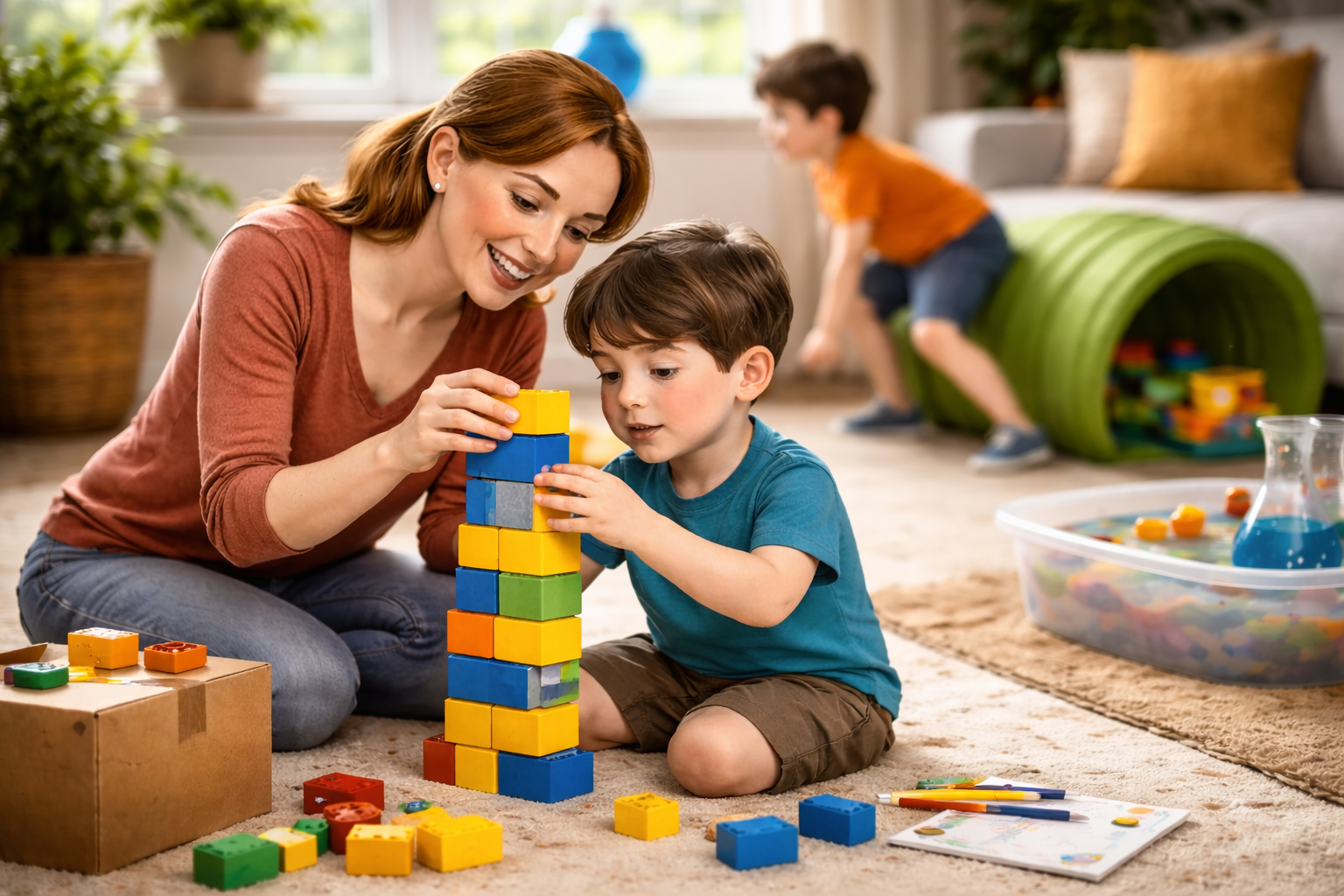
This can be a Lego city, Magna Tiles,(car garage, skyscraper, or something familiar) cardboard forts, marble runs, craft sticks or train tracks.
Start it together. Set a loose theme if needed. Then step back.
Some kids want you nearby. Others want you gone but available. Both are fine.
Why it works:
Shared building gives proprioceptive and visual input while allowing control and independence [1].
These activities can turn into long stretches of focused play once the pressure to “do it right” is removed. My son can go for forty minutes if I help with the first five-ten.
This works just as well with boxes, paper towel rolls, bedding/pillows and whatever’s in the house.
Choose one medium. Paint. Clay. Chalk. Watercolors. Slime. Window painting. Ice towers with embedded objects, (beads, lego characters, cars) rainbow soap foam.
The only rule is that it stays on the surface or bucket you choose.
No crafts. No outcome. No sample project. Just messy, contained fun.
Why it works:
Tactile input paired with creativity helps kids regulate and engage for longer [3.]
This works best when adults resist the urge to comment. Silence keeps kids engaged longer than praise.
Obstacle courses, scavenger hunts, or timed challenges using household items.
Crawl under chairs. Jump between pillows. Carry heavy books from one room to another. Roll a ball back and forth to knock over targets.
Why it works:
Movement based sensory input improves regulation and attention in school aged kids [2].
Kids engage longer when the activity has a purpose rather than “do this because it helps.”
Board games that involve working toward a shared goal, building something together, or storytelling games where there is no winner. For kids (like mine) who can’t handle losing, this removes the emotional landmine.
Why it works:
Collaborative play supports social tolerance without activating fight or flight responses [1].
These games can become a bridge to more traditional games later.
This one matters. Once I stopped trying to introduce “new” activities and instead layered onto his interests, my son was far happier to give it a go- and liked it!
If your child loves cars, incorporate ramps, tracks, and washing stations.
If they love books, act scenes out physically or build settings.
If they love science, mix sensory experiments with predictable outcomes.
Why it works:
Pairing sensory input with special interests increases motivation and endurance [1].
Water play in particular often holds attention far longer- even when it’s just a bowl, cups, and a towel underneath.
Then stop pushing.
Refusal is data, not defiance.
Some days your child needs sameness more than expansion. Some weeks are about survival. That does not mean you are doing anything wrong.
A friend once shared that her daughter rejected every group activity for months. When she stopped asking and simply stayed nearby, her child joined on her own.
Regulation always comes before participation.
Here’s the tough part that often gets glossed over. There are no universal strategies that work for every child, because behaviors serve different functions.
Some sensory behaviors are fully self directed. No one is giving access. No one is reinforcing them. The child controls the input entirely. That is why these behaviors are often difficult to replace with another activity, and why forcing alternatives can backfire.
This is also why most effective strategies do not require long follow through. Parents are busy. Kids are tired. If something needs forty minutes of setup or perfect execution, it usually will not last.
Our therapists tend to focus less on adding more activities and more on:
Tools like first then boards, visual schedules, transition songs or objects, and simple counting often do more for afternoon regulation than adding another sensory bin.
And just as important, most children cannot access strategies without guidance. Trying something once, watching it fall apart, and assuming “we tried that” may feel like failure. It’s not. Skills need to be taught in a way that matches your child.
This is where individualized support matters.
Afternoons are often harder for elementary aged autistic kids than for toddlers or even teens. By the time they get home, they have spent hours holding it together. Sitting still. Following rules. Managing noise, transitions, and expectations. Masking more than we realize. Even when they look fine, their nervous systems are depleted.
Independent play and special interests are not problems to solve. They are anchors- safe zones that allow recovery after long, demanding days. Flexible sensory support early on helps kids grow into tweens and teens who can adapt, tolerate boredom, and stay connected without losing themselves.
Some days, the book stays open for the eighteenth time and that is okay. Other days, you stretch the afternoon just a little. A shared build. A cooperative challenge. Ten minutes longer than yesterday. Support, not force, is the goal.
Want more ideas that actually work in (and out) the home?
At Shining Steps, our family guided ABA approach is built around this philosophy. We focus on understanding the function behind behaviors, teaching strategies in real time, and creating plans that fit your child and your home.
References:
1.https://pmc.ncbi.nlm.nih.gov/articles/PMC6452625
2.https://www.nature.com/articles/s41598-025-05393
3.https://www.sciencedirect.com/science/article/abs/pii/S0197455609001002